Click here to listen to this sermon.
The Christmas season is marked with many decorations: trees laden with shiny ornaments and twinkling lights, evergreen wreaths and garland, tinsel and toys, poinsettias and peppermint, ribbons and bows, candy canes and candles, hung stockings and gingerbread houses. These can be beautiful and meaningful, enhancing our celebration of Christmas. But sometimes, the holiday becomes cluttered with such wrappings and trappings, making it difficult to sort out what Christmas is really about. It’s hard to get down to the core message.
I think if you asked many people what the most important thing about Christmas is, they’d say the presents. For them, the highlight of the holiday is unwrapping those packages under the Christmas tree. This may be especially true for children. For them, opening presents is the climax of the Christmas season. I This is when they get to tear open those colorfully wrapped boxes that have been enticing them for weeks. Their presents have been foremost in their minds.
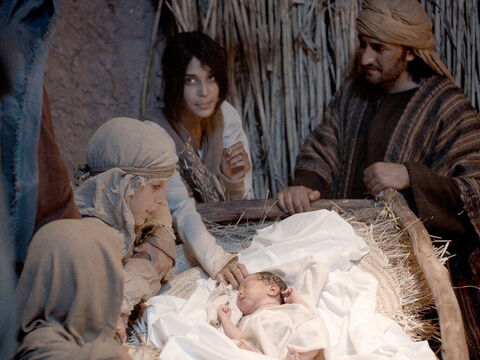
Actually, Christmas is about a gift. That gift is not found under the Christmas tree. The most important truth about Christmas sometimes gets lost in our attention to the glitter and glitz of the holiday. It may get hidden behind the Santas and snowmen and shopping. But the most meaningful truth of Christmas is the message of the most important gift. This gift is a small, sleeping newborn baby lying in a manger, who has come to save His people from their sins.
During Advent, we have looked at common decorations used for this holiday season and how they prepare us for the coming of Christ. Now that we have come to Christmas, we celebrate Christ’s arrival. The first Christmas gift was God’s Son, who was born as a baby, born to save us. And this is the real gift of Christmas!
Centuries earlier, God, through His prophets, had promised a gift to humanity. That gift arrived more than two thousand years ago in the package of a little baby, an infant who was God in human flesh. The promised Immanuel—“God with us”—had arrived. He came to deliver us from our captivity to sin and death. He came to be our Savior.
This was the gift that the angel announced to the shepherds on that first Christmas night. He said, “For unto you is born this day in the city of David a Savior, who is Christ the Lord. And this will be a sign for you: you will find a baby wrapped in swaddling cloths and lying in a manger” (Luke 2:11–12).
We decorate our Christmas presents with colorful paper and beautiful bows affixed on top. But this gift was wrapped in swaddling cloths—strips of fabric that enveloped a newborn infant. We attach tags to our wrapped presents that identify the intended recipients. The angel identified to whom the gift of baby Jesus was given: “For unto you is born this day in the city of David a Savior.” We find our holiday packages under the Christmas tree. But this gift was to be found in a manger, a feeding trough for animals. We tear into our wrapped presents to discover their contents. On that first Christmas, the angel announced the content of the newly delivered package—“a Savior, who is Christ the Lord.”
This was the gift we needed more than any other—a Savior. We needed someone to save us from our sins. As the Christmas carol “God Rest Ye Merry Gentlemen” says, we needed someone “to save us all from Satan’s power when we had gone astray.” We had gone astray from God and His commandments in our selfish desires and sinful rebellion. We had been imprisoned under Satan’s power and were oppressed under his tyrannical rule. We were destined for death and eternal destruction. More than anything else, we needed a Savior to deliver us from sin and its deadly consequences.
In His grace, God delivered the gift of a Savior in the babe of Bethlehem. This is why the child was named Jesus, meaning “the Lord saves,” for it was announced that “He will save His people from their sins” (Matthew 1:21). God entered our world as a human to rescue humanity—living a righteous life and dying a sacrificial death on account of our unrighteousness. As true God, He saved the entire human race—conquering Satan and destroying death for us. Jesus Christ, the Savior, is the real gift!
Why did God send us this real gift of a Savior? Why did He enter human flesh to be born as a baby in Bethlehem? The apostle Paul provides us the answer, writing in Titus 3:4–5, “But when the goodness and loving kindness of God our Savior appeared, He saved us not because of works done by us in righteousness but according to His own mercy.” This passage expressly states that our salvation was “not because of works done by us in righteousness.” Unlike Santa Claus, who gives gifts only to good little boys and girls, God’s gift of salvation is not dependent on our good works or behavior. Instead, He gives the gift of the Savior purely out of His unmerited mercy, grace, and unconditional love.
Today, as we gaze in the manger, we see a message wrapped in swaddling cloths—which explains God’s real gift to us. He says, “I did it for love.” In the gift of Jesus Christ, God has given us His greatest gift because He has given us Himself. It was because of love that the infinite Creator of the universe took on a created body, and a helpless infant one at that! It was for love that He grew up to offer His life as a ransom for sinners. As Paul says, “The goodness and loving kindness of God our Savior appeared.” Because of His life, death, and resurrection, you are forgiven and delivered from eternal death.
But there is more! This real gift of a Savior given by God’s love brings additional gifts. Advertisers have used the phrase “The gift that keeps on giving” to sell products they think will please consumers on an ongoing basis. Most of us recognize, however, that these gifts fail to satisfy us for long. But this Christmas gift, the gift of the Savior, has a permanent lasting effect. Jesus brings a salvation that endures forever.
Moreover, He is the gift that keeps on giving! Today’s Epistle identifies some of those gifts that result from the coming of the Savior. Titus 3:4–7 states, “But when the goodness and loving kindness of God our Savior appeared, He saved us . . . by the washing of regeneration and renewal of the Holy Spirit, whom He poured out on us richly through Jesus Christ our Savior, so that being justified by His grace we might become heirs according to the hope of eternal life.”
Do you hear how Paul lists one gift after another, piling them on top of one another? By receiving the gift of the Savior, we also receive the washing of regeneration, the cleansing from sin delivered through the new birth of Baptism. We receive the renewal of the Holy Spirit; God’s Spirit indwells us and renews our lives daily. We receive the gift of justification—God’s declaration that we are right with Him through Christ’s righteousness imparted to us by grace. And we receive an inheritance, named to be heirs of eternal life. In giving us the real gift—Jesus Christ, the Savior—God piles on a treasury of resultant gifts: regeneration, renewal, justification, and eternal life. This truly is the gift that keeps on giving, even into eternity!
All other gifts pale in comparison to the one gift that is the real reason for the Christmas season—the gift of the newborn baby wrapped in swaddling cloths and lying in a manger, our Savior Jesus Christ. This Christmas, we joyfully receive that supreme gift announced by the angel: “For unto you is born this day in the city of David a Savior, who is Christ the Lord.” Amen


 St. Paul's Lutheran Church, Ferney, SD
Leave a comment