Click here to listen to this sermon.
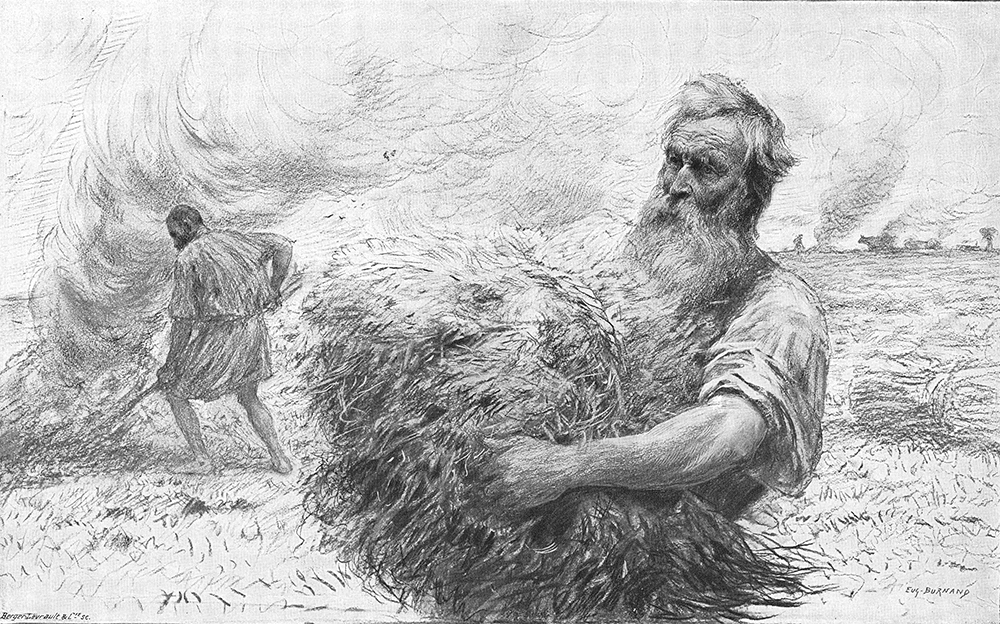
27And the servants of the master of the house came and said to him, ‘Master, did you not sow good seed in your field? How then does it have weeds?’ 28He said to them, ‘An enemy has done this.’ So the servants said to him, ‘Then do you want us to go and gather them?’ 29But he said, ‘No, lest in gathering the weeds you root up the wheat along with them. 30Let both grow together until the harvest, and at harvest time I will tell the reapers, Gather the weeds first and bind them in bundles to be burned, but gather the wheat into my barn’”(Matthew 13:27-30).
Grace to you and peace from God our Father and the Lord Jesus Christ!
One of my favorite sports movies is Hoosiers. Gene Hackman plays a veteran basketball coach who takes over a small-town Indiana high school team in the 1950s. Right from the beginning, everyone thinks he’s doing everything wrong. During the first practices, he won’t even let the boys touch a basketball. In early-season games, he requires them to make four passes before taking a shot—even if they have an open look. They lose games they should have won. The townspeople become impatient. They question his judgment. Some even want him fired.
But the coach knows something they don’t. He isn’t trying merely to win the next game. He’s shaping the team into champions. His players cannot yet see what he sees. Eventually, everything comes together, and the tiny school wins the state championship.
Sometimes we look at God the same way. We see evil flourishing. We see wicked people prospering. We see false teaching confusing Christians. We see injustice, violence, abuse, and corruption. We look at the world and wonder, “Lord, why don’t You do something? Why don’t You remove the wicked? Why don’t You clean up the field now?”
Those questions are not new. They are exactly the questions Jesus answers in today’s Gospel.
Jesus tells us about a farmer who sowed good seed in his field. During the night, an enemy came and sowed weeds among the wheat. When the plants began to grow, the servants noticed the weeds and immediately asked, “Master, did you not sow good seed in your field? How then does it have weeds?”
The master answered, “An enemy has done this.”
So far, everything makes sense. But then comes the surprising part.
The servants ask, “Then do you want us to go and gather them?”
If we were listening for the first time, we would expect the master to say, “Yes! Get rid of them immediately.” Instead, he says, “No.” “No, lest in gathering the weeds you root up the wheat along with them. Let both grow together until the harvest.” That answer seems strange to us. We want immediate justice. We want immediate judgment. We want God to solve every problem right now.
But the Lord sees farther than we do. We see only what we can see, and only over a very short horizon. God sees the invisible and the future, on into eternity—which means God’s ways will often be different, and always wiser, than ours. Which also means we may become impatient with God and jump to conclusion He knows would be foolish. Like the veteran coach, God knows what is best for our and everyone’s future. And that is what He—as God!—will do.
Later, when the disciples ask Jesus to explain the parable, He identifies every part of the story. The Sower is the Son of Man, Jesus Himself. The good seed is the sons of the Kingdom. The weeds are the sons of the evil one. The enemy is the devil. The harvest is the end of the age. The reapers are the angels.
Then Jesus tells us something that changes how we understand the whole parable. The field is the world. This world has become a battlefield. God created it good. But the devil has been busy sowing rebellion, deception, hatred, and unbelief. Ever since Adam’s fall, the weeds have multiplied. Everywhere we look, we see evidence of sin. Families are broken. Nations wage war. Children suffer. Lies are celebrated. The truth is despised. Even within the visible Church, there are hypocrites, scandals, and false teachers. Sometimes it appears as though the weeds are winning.
So why doesn’t God simply destroy them? Because He is still gathering His harvest. The patience of God is not weakness. The patience of God is mercy. St. Peter writes, “The Lord is not slow to fulfill His promise… but is patient toward you, not wishing that any should perish, but that all should reach repentance.” That means every day this world continues is another day of grace.
Think about your own life. There was a time when you did not know Christ. There was a time when you were dead in trespasses and sins. There was a time when you, too, belonged to the kingdom of darkness.
If Christ had returned before the Gospel reached you… before you were baptized… before someone spoke His Word to you… before He brought you to faith… where would you be?
God delayed the harvest so that you might become wheat, so that you might be gathered into His barn. And He is still delaying the harvest because there are others whom He intends to bring into His kingdom. That changes how we see God’s patience.
Before we begin thinking about “those people” out there, Jesus first turns our attention inward. It is easy to point to the weeds in society. It is much harder to recognize the weeds growing in our own hearts. We condemn greed while clinging to our possessions. We condemn anger while nursing our grudges. We condemn pride while quietly congratulating ourselves for being better Christians than someone else. We condemn gossip while enjoying hearing it. The old Adam continues producing weed-like fruit every day.
That is why we have gathered here today. Not first to complain about society. Not to congratulate ourselves for noticing the world’s sins. But to repent. The Law exposes the weeds that still cling to us.
Yet the Gospel announces something far greater. The Sower has not abandoned His field. The Son of God entered this very field. He came into a world overrun with weeds. He endured rejection, hatred, betrayal, false accusations, and violence. Though perfectly righteous, He allowed Himself to be treated as though He were the weed. On the cross He bore the judgment that our sins deserved. The fire of God’s wrath fell upon Him so that it would never fall upon those who belong to Him. His resurrection declares that His sacrifice has been accepted.
Now the Sower continues His work. He does not merely wait for the harvest.
He continues sowing. Through the preaching of the Gospel, Christ plants faith where there was unbelief. In Holy Baptism, He clothes sinners with His own righteousness and makes them children of His Father. Through Holy Absolution, He continually forgives our sins. In His Holy Supper, He feeds us with His own Body and Blood, strengthening the faith that He Himself has planted. Every Divine Service is another act of the patient Sower caring for His field.
Because Christ continues His work, we are called to continue ours.
Notice what Jesus does not tell His Church to do. He does not tell us to become harvesters. He does not tell us to pronounce eternal judgment on people. He does not tell us to uproot everyone whose faith seems weak. Instead, He calls us to keep sowing His Word. This does not mean ignoring false doctrine or refusing to practice Christian discipline. Scripture commands both. Love calls sinners to repentance. Love protects the flock from false teaching. But there is a profound difference between calling someone to repentance and assuming the role that belongs only to Christ. Only the Lord knows every heart. Only He knows what His Gospel may yet accomplish. Only He knows when the harvest is ready.
Our task is not to do the sorting. Our task is to sow faithfully, speak truth lovingly, forgive generously, and trust patiently. That is often difficult. We grow weary. We become discouraged. We wonder whether anything is changing.
Yet the Lord of the harvest has never lost control of His field. The day will come. Jesus promises it. The angels will go out. The weeds will be gathered. Every injustice will end. Every falsehood will be silenced. Every tear will be wiped away. Every enemy of Christ will be judged. And then, Jesus says, “The righteous will shine like the sun in the kingdom of their Father.”
Notice where our eyes finally rest. Not on the weeds. Not on the fire. But on the Father’s kingdom. On the glory Christ has prepared for His people.
Until that day comes, we wait. Not with despair. Not with frustration. But with confidence. The Sower who planted you by His Word has not forgotten you. The Shepherd who laid down His life for His sheep knows every stalk of wheat that belongs to Him. He claimed you in Holy Baptism. He continues to feed you with His own Body and Blood. He daily forgives your sins. He preserves you by His Holy Spirit. And when the harvest finally comes, not one believer will be overlooked. He will gather you safely into His everlasting barn, where sin, death, weeds, and sorrow shall never trouble you again.
So, when evil seems to flourish, do not lose heart. Trust the wisdom of your Lord. His patience is not delay without purpose. His patience is saving mercy. And He who began His good work in you will surely bring it to completion on the Day of Christ Jesus.
In the name of the Father and of the Son and of the Holy Spirit. Amen.


 St. Paul's Lutheran Church, Ferney, SD
Leave a comment